Your Trainer
Gedi Balodas
Gedi Balodas is a business productivity consultant and entrepreneur.
In 2002, Gedi became one of the first in the world to receive certification from Theory of Constraints International Certification Organization (TOCICO).
He led successful implementations in more than 20 large and mid-size companies in the manufacturing, distribution, and project management fields in Europe and Asia.
He also spoke at numerous international and local conferences sharing the success of his projects.
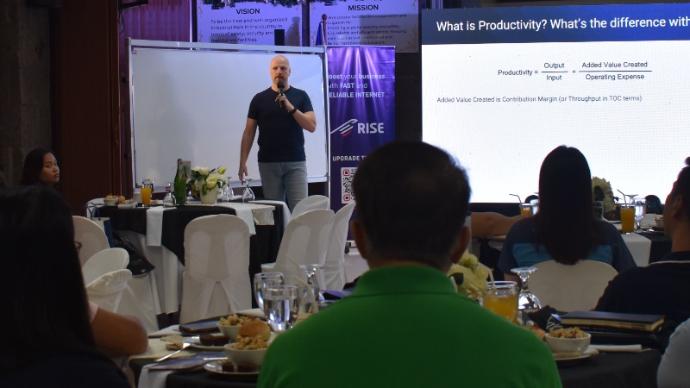
Focused Approach
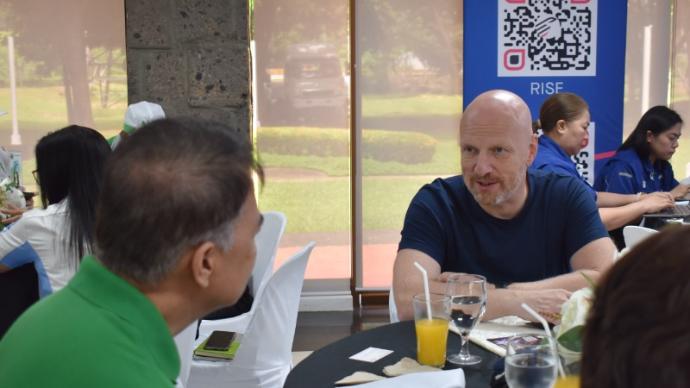
Tailor-Made In-House Trainings
To ensure maximum relevance and impact, all key challenges are thoroughly discussed with the management team in advance, so the training directly addresses the company’s real obstacles of growth and strategic priorities.
Your Challenges
TOC Trainings are designed to teach top managers how to improve rapidly, significantly, and sustainably the operational and bottom-line performance of their company.
During the program, executives gain a deep understanding of the principles of the Theory of Constraints (Constraints Management) as applied to production, learning how to identify and manage the factors that most limit growth.
Choose topics that cover the key challenges that your company is facing.
1.
Management Accounting And Decision Making
Challenges Addressed:
Poor managerial decisions based on misleading cost accounting information.
Suboptimal product mix decisions.
Incorrect make-or-buy decisions.
Poor investment decisions.
Uncompetitive or lost sales due to incorrect pricing.
Lack of clarity on true drivers of profitability.
Conflicting local performance measures.
2.
Cash Constraint Management
Challenges Addressed:
Insufficient cash flow to support operations and growth.
Missed sales opportunities due to lack of working capital.
Inability to accurately forecast short-term and medium-term cash availability.
3.
Production Planning And Execution The TOC Way
Challenges Addressed:
Too long lead times.
High levels of work-in-process (WIP) inventory.
Late deliveries and poor customer service.
High operational expenses due to inefficiencies.
Poor prioritization of orders.
Lack of visibility and control over production flow.
Firefighting and reactive management.
More Details4.
Boosting A Lean Manufacturer With Theory Of Constraints
Challenges Addressed:
Limited improvement from Lean initiatives.
Inability to effectively leverage existing lean practices.
High WIP and long lead times persisting despite Lean efforts.
Difficulty in scaling improvements across complex plants.
Lack of a clear strategy for continuous improvement beyond basic waste reduction.
Frustration with the pace and magnitude of improvement.
5.
Thriving In Engineer-To-Order And Multi-Project Environments
Thriving In Engineer-To-Order And Multi-Project Environments
Challenges Addressed:
Frequent project delays and missed deadlines.
Frequent project cost overruns.
Reduced project quality.
High levels of stress and frustration among project teams.
Inability to effectively manage dependencies between projects.
Difficulty in prioritizing projects and allocating resources effectively.
Inability to deliver projects reliably on time, on scope, and on budget.
6.
TOC Distribution Solution
Challenges Addressed:
High levels of inventory across the supply chain.
Stock-outs and lost sales.
Long lead times in replenishment.
High distribution costs.
Poor forecasting accuracy leading to inventory imbalances.
Ineffective management of seasonality.
High levels of obsolete or slow-moving inventory.
Inability to effectively manage variability and uncertainty in demand.
.
7.
What’s Next After The Lean / Toyota Production System?
Challenges Addressed:
Plateauing of benefits from Lean/TPS implementation.
Frustration with the limitations of Lean/TPS.
Focusing on local efficiencies at the expense of global flow.
Confusion about the core principles and intentions behind Lean/TPS.
Struggling to adapt Lean/TPS to complex or highly variable environments.
8.
How To Turn An ERP Into A Cash Machine
Challenges Addressed:
ERP implementation failing to deliver expected financial benefits.
Lack of real-time visibility and control over production flow despite ERP.
High levels of work-in-process (WIP) and finished goods inventory.
Late deliveries and poor customer service despite erp investment.
Inefficient resource utilization.
Inability to effectively manage priorities on the shop floor.
Lack of integration between sales and operations planning (S&Op) within the ERP.
Difficulty in achieving high reliability in delivery.
Next Steps
Discuss
Challenges
1 hr online meeting to identify the critical challenges whose resolution delivers the greatest bottom-line impact
Quick Assessment
A site visit or online meeting is conducted to gather specific information, ensuring the training is highly practical and focused
Agree On Agenda
We align on workshop topics, schedule, location, and preparatory materials (videos, readings), while also confirming the participant list
Conduct
Trainings
The sessions may be recorded solely for internal use
After-training support
Four weeks after the training, the trainer remains available for unlimited Q&A on short notice